
Custom Silicone Glass Bottle Sleeve | UK 2021 Project

|
Product |
Cylindrical Silicone Glass Bottle Sleeve with Cutout Design |
|---|---|
|
Order Quantity |
Initial Order: 15,000 pcs |
|
Material |
Food-Grade Solid Silicone |
|
Key Specs |
Hardness: Shore A40 Temperature Resistance: -40°C to 230°C |
|
Certification |
LFGB, FDA, BPA-Free |
|
Lead Time |
DFM Evaluation: 24 hrs |
Project details
A British brand specializing in bottle and accessory protective products planned to develop a heat-resistant and non-slip glass sleeve. After the client designed and produced a prototype, several issues were revealed during testing: stress concentration at the edges of the holes, poor fit between the sleeve’s diameter and the glass, and inconsistent hole wall forming quality.

Z.S.R’s engineering team conducted a DFM (Design for Manufacturing) evaluation of the samples within 24 hours, optimizing the perforations, sleeve diameter, and venting structure to help the customer improve product molding quality and assembly compatibility.
Based on the DFM results, the project moved into mold making and sample production, followed by quality verification of the first batch before mass production.
Delivery data
Engineering DFM Assessment
Rounded Cornering of Hole Edges

Z.S.R changed the honeycomb shape of the hole in the sleeve to a teardrop shape; added a 0.5 mm radius to the edge of each hole, and made a smooth transition at the root of the hole wall.
Honeycomb-shaped holes easily trap dust and coffee stains during use, requiring a small brush for cleaning. Teardrop-shaped holes provide a non-slip effect and are easier to clean; sharp-angled hole edges can cause the hole wall to fit too tightly to the core rod during demolding, making it easy for the wall to tear under strong pulling. The added R0.5 mm radius at the hole edges disperses single-point stress to the curved surface, ensuring smooth and complete demolding.
Precise Control of Sleeve Diameter Interference
Based on the elastic recovery characteristics of silicone Shore 40A, the interference of the sleeve’s inner diameter was precisely calculated to be 0.8 mm; a 0.6 mm raised ring was set around the upper and lower edges of the bottle sleeve; the inner diameter was controlled by the mold positioning reference, with a target tolerance of ±0.2 mm.
The bottle sleeve relies on interference fit to elastically hold the glass. Too much interference makes the sleeve too tight and difficult to install, while too little results in a loose fit that easily slips. A 0.8 mm interference fit, designed according to the elastic recovery characteristics of 40A silicone, combined with the raised rings at the top and bottom rims, ensures the bottle sleeve fits snugly against the glass wall; strict control of the inner diameter tolerance of the mold positioning datum ensures that the diameter of each sleeve is consistent.
Thickening and Edge Binding of Upper and Lower Edges
The engineers thickened the upper and lower edges of the sleeve from 1.8 mm to 2.4 mm, and used a 1.0 mm radius rounded edge binding at the opening to improve the rigidity of the opening.
The rim is the area repeatedly subjected to force when installing the glass; if it is too thin, it is prone to tearing. The top and bottom edges are thickened to 2.4 mm and rounded to improve the bending resistance of the edge, so it will not crack even after repeated use.
Mold Making, Sample Production & Quality Verification

Mold Processing
Z.S.R Group is equipped with 10 advanced CNC machining centers and 4 EDM machines, capable of creating silicone bottle sleeve molds. Core rods with hollowed-out holes are precision machined, cavities are mirror-polished, and parting surfaces are high-precision ground, with strict control over flash.

Silicone Molding
Production is supported by 48 solid-state molding machines, 12 liquid molding machines, and 13 injection molding silicone machines, using a solid-state molding integrated process that can rapidly produce 15,000 silicone bottle sleeves within 18 days. Over 10 printing and spraying production lines also allow for printing logos or patterns on silicone glass bottle sleeves.

Secondary Vulcanization
After molding, the silicone glass bottle sleeves undergo secondary vulcanization at 200°C for 2 hours.
The secondary curing process removes small-molecule volatiles from the silicone, reduces product odor, and ensures the sleeves meet food contact safety standards.
Quality Inspection
|
Test |
Condition |
Acceptance Criteria |
Result |
|---|---|---|---|
|
Cutout Tear Resistance Test |
Repeatedly pull and rub the cutout edges 2,000 times |
No tearing or cracking around the cutout edges |
Pass |
|
Sleeve Fit Fatigue Test |
Repeatedly fit and remove the sleeve from a glass bottle 5,000 times |
No tearing, deformation, or visible stress whitening |
Pass |
|
Grip and Anti-Slip Test |
Fit the sleeve onto a glass bottle, then invert and shake vertically |
Sleeve remains securely fitted without slipping off |
Pass |
|
Thermal Cycling Test |
50 heating and cooling cycles between -40°C and 230°C |
No deformation, cracking, delamination, or oil exudation |
Pass |
|
Dimensional Tolerance Inspection |
Measure the inner diameter and cutout dimensions using a 2D optical measuring system |
Dimensional deviation within ±0.2 mm; cutouts properly aligned |
Pass |
|
Visual Inspection |
100% visual inspection of the sleeve surface |
No bubbles, incomplete filling, flash, or scratches; smooth cutout edges |
Pass |
|
Food Contact Migration Test |
Tested in accordance with applicable LFGB and FDA requirements |
No unacceptable migration of harmful substances; meets applicable food-contact requirements |
Pass |
The production samples passed the specified cutout tear resistance, sleeve fit fatigue, grip and anti-slip, thermal cycling, dimensional, visual, and food contact inspections. In particular, we observed no tearing or stress whitening after 5,000 fit/removal cycles.
Related Product


Customer reviews & feedback
The UK customer was very satisfied upon receiving the goods: “This bottle sleeve fits our glasses perfectly and doesn’t slip off. The color is also fantastic! Thank you!” The customer subsequently placed a follow-up order for 30,000 more.
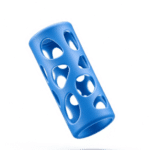

Custom Silicone Glass Bottle Sleeve
OEM & ODM solutions for brands, retailers, wholesalers, and Ecommerce sellers. Food-grade silicone glass bottle sleeves with LFGB/FDA compliance.
Other Project


For industrial-scale production, ZSR Group also operates a dedicated silicone compression molding service for custom silicone parts.
