
Custom Silicone Pot Lid | Polish 2025 Project

|
Product |
Round Food-Grade Silicone Universal Pot Lid |
|---|---|
|
Order Quantity |
Initial Order: 40,000 pcs |
|
Material |
Food-Grade Solid Silicone |
|
Key Specs |
Hardness: Shore A60 |
|
Certification |
LFGB, FDA Compliant, BPA-Free |
|
Lead Time |
DFM Evaluation: 24 hrs |
Project details
A Polish kitchenware brand specializes in high-temperature resistant household cooking accessories. The client wanted to design a silicone pot lid with a handle, but the original design had several issues during production and use: steam easily leaked from the lip, the central handle would break, and the ear pieces were unstable in their molding.

To address these issues, Z.S.R’s engineering team conducted a DFM evaluation on the samples, employing a double-layer corrugated sealing lip combined with a ring-shaped unloading groove design for the handle. The samples demonstrated stable sealing during high-temperature stewing and did not break even after repeated use.
Based on the DFM results, the project moved into mold making and sample production, followed by quality verification of the first batch before mass production.
Delivery data
Engineering DFM Assessment
Double-Layer Composite Wave Sealing Lip Structure

Z.S.R adopted a double-layer wave structure with a main sealing lip and an auxiliary compensation lip. The wall thickness of the main lip is adjusted to 1.4 mm, and the auxiliary compensation lip is thinned to 0.6 mm, with six arc-shaped buffer corrugations evenly distributed along the circumference.
Silicone expands thermally at high temperatures. A single-layer lip will expand outwards, reducing compression and causing steam leakage, and will permanently deform upon cooling. The double-layer wavy lip absorbs radial dimensional changes caused by thermal expansion and contraction, maintaining a tight fit at room temperature and continuously maintaining sealing pressure during high-temperature cooking, preventing steam leakage and lid deformation.
Gradual Wall Thickness of Handle Base + Annular Stress Relief Groove
The original handle design had a right angle at the root with a sudden change in wall thickness, making it prone to breakage in hot and cold cycling environments. The handle is tapered downwards with a gradual reduction in thickness, and an annular concave stress relief groove is added to the root of the base to distribute the tension concentrated at the root point to the lid body along the annular groove.
The handle is a high-frequency stress area. A right-angle structure combined with abrupt changes in wall thickness amplifies fatigue damage during thermal cycles. The annular stress relief groove disperses concentrated stress, preventing stress accumulation at the root and improving the handle’s fatigue life under repeated lifting.
Flowing Arc Design of Anti-Slip Ear Plates + Auxiliary Inlet Rib Design
The original ear plate design had thin walls, a closed distal end, a long melt flow path, difficult venting, and easy deformation during demolding. The engineering team changed the outer contour of the ear plate to a large R-shaped flowing arc, added auxiliary flow channel ribs at the root, and made a gradual thickening of the wall thickness in some areas. At the same time, the end venting groove was optimized to eliminate insufficient material and air bubbles, and reduce demolding stretching deformation.
The ear plates are thin-walled structures at the distal end. Simply thickening them would increase the product’s weight. The added auxiliary injection ribs improve mold filling and solve the problem of insufficient material and air bubbles at the ends. The streamlined arcs eliminate sharp corner stress points, improve the ear plates’ tear resistance, and reduce the rate of defects caused by demolding deformation.
Mold Making, Sample Production & Quality Verification

Mold Processing
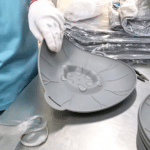
Z.S.R Group is equipped with 10 advanced CNC machining centers and 4 EDM machines for silicone pot lid mold making. High-stress areas such as the sealing lip, handle base, and ear pieces are mirror-polished, and the parting surface is high-precision ground to strictly control flash.

Silicone Molding
Production is supported by 48 solid molding machines, 12 liquid molding machines, and 13 injection molding silicone machines, enabling the rapid molding of 25,000 silicone pot lids within 20 days. Over 10 printing and spraying production lines also allow for printing logos or patterns on the silicone pot lids.

Secondary Vulcanization
After molding, the silicone pot lids undergo secondary vulcanization at 200°C for 2 hours.
The secondary curing process removes small-molecule volatiles, meeting the requirements for high-temperature food contact use.
Quality Inspection
|
Test |
Condition |
Acceptance Criteria |
Result |
|---|---|---|---|
|
High-Temperature Steam Sealing Test |
230°C high-temperature steam, 4 hours duration, 50 cycles, lid fitted on matching pot body |
No obvious steam leakage; no permanent deformation on sealing lip |
Pass |
|
Handle Fatigue Test |
Vertical cyclic load of 5 kg, 3,000 cycles |
No fracture or cracks on the handle |
Pass |
|
Thermal Cycle Endurance Test |
800 thermal cycles between -40°C and 230°C |
No cracking, obvious permanent deformation or abnormal stress marks; no significant degradation of sealing performance |
Pass |
|
Tab Tear Resistance Test |
Tensile test on tabs using tensile tester |
No tearing or damage at the root |
Pass |
|
Dimensional Inspection |
Vision measuring system checks critical dimensions of sealing lip, handle and tabs |
Critical dimensions meet tolerance requirement of ±0.10 mm |
Pass |
|
Visual Inspection |
100% visual inspection of product surface |
No defects such as bubbles, sink marks, flash or weld lines |
Pass |
|
Food Contact Migration Test |
LFGB & FDA relevant food contact testing |
Complies with applicable food contact requirements of the project |
Pass |
The production samples passed the specified steam sealing, handle fatigue, thermal cycle endurance, tab tear resistance, dimensional, visual, and food contact inspections. In particular, no obvious steam leakage was observed after 50 cycles of 230°C steam testing.
Related Silicone Pot Lid Product


Customer reviews & feedback
“I just opened the package, and after a long day at work, we were so happy to see the pot lids! They look fantastic! Thank you so much for your help.”
Custom Silicone Lid
OEM & ODM solutions for brands, retailers, wholesalers, and Ecommerce sellers. Food-grade silicone pot lids with LFGB/FDA compliance.
Other Project


For industrial-scale production, ZSR Group also operates a dedicated silicone compression molding service for custom silicone parts.
