
Custom Silicone Cup Sleeve | Spanish 2025 Project

|
Product |
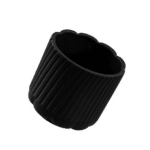
Silicone Cup Sleeve with Vertical Stripes and Petal-Shaped Opening |
|---|---|
|
Order Quantity |
Initial Order: 30,000 pcs |
|
Material |
Food-Grade Solid Silicone |
|
Key Specs |
Hardness: Shore A45 Temperature Resistance: -40°C to 220°C |
|
Certification |
LFGB, FDA, BPA-Free, Phthalate-Free |
|
Lead Time |
DFM Evaluation: 24 hrs |
Project details
A Spanish beverage accessory brand wanted to develop a petal-shaped cup sleeve that was practical, non-slip, and decorative. The client’s original design had three main problems: the ribs were prone to breakage at the base, the petal edges were difficult to unmold, and the cup was not stable enough.

Z.S.R’s engineering team provided professional solutions through DFM (Design for Manufacturing) assessment to address issues in the client’s original design: optimizing the rib and petal structure, adding a bottom suction cup design, and stabilizing the nozzle dimensions. This improved the product’s user experience and molding stability.
Based on the DFM results, the project moved into mold making and sample production, followed by quality verification of the first batch before mass production.
Delivery data
Engineering DFM Assessment
Rib Base Rounding and Cross-Section Optimization

Z.S.R added a 0.4 mm radius rounded corner at the rib base, changed the rib tip to an arc, and changed the rib cross-section from triangular to a rounded trapezoid. All ribs are evenly distributed at equal intervals, and the height is uniformly adjusted to 0.6 mm.
The original design had right-angled rib bases, which easily caused mold adhesion and tearing during demolding. Stress during bending concentrated at the right-angle inflection point, and repeated use led to rib breakage. Adding a 0.4 mm radius rounded corner disperses stress, and the rounded trapezoidal cross-section reduces demolding resistance, improving the lifespan of the cup sleeve.
Petal Rounding Optimization and Base Thickening
All sharp corners of the petals are adjusted to a smooth 3 mm radius arc. The wall thickness at the base is increased from 1.6 mm to 2.0 mm, while the tip thickness remains at 1.8 mm.
During molding and demolding, the stress in the pointed petals concentrates at the sharp corners, easily causing whitening and tearing. The base and tip of the petals have the same wall thickness, resulting in insufficient strength at the base. A 3 mm full-rounded transition disperses the concentrated stress onto the curved surface, reducing the risk of demolding tearing. Thickening the petal base while maintaining the tip wall thickness balances appearance and structural strength.
Bottom Suction Cup Structure Added
Engineers placed four evenly distributed small circular suction cups at the bottom of the cup sleeve. The suction cup lip is thickened to 0.4 mm, and a 0.3 mm radius transition rounded corner is added to the base of the suction cup. A 0.02 mm vent groove is added to the suction cup cavity. The suction cup depth is uniformly 1.2 mm.
The added suction cup structure at the bottom of the cup sleeve prevents tipping. The thickened suction cup lip, combined with the rounded base to disperse stress, and the venting groove to expel air from the cavity, along with the 1.2 mm depth of the suction cup, creates a stable vacuum suction.
Mold Making, Sample Production & Quality Verification

Mold Processing
Z.S.R Group is equipped with 10 advanced CNC machining centers and 4 EDM machines, capable of creating silicone cup sleeve molds. Cavities undergo mirror polishing; petals, ribs, and bottom suction cup cavities are machined with high precision; suction cup cavities are individually polished to ensure a smooth, burr-free suction cup lip.

Silicone Molding
Production is supported by 48 solid molding machines, 12 liquid molding machines, and 13 injection molding silicone machines, enabling 30,000 silicone cup sleeves to be rapidly molded within 20 days. Over 10 printing and spraying production lines also allow for printing logos or patterns on the silicone cup sleeves.

Secondary Vulcanization
After molding, the silicone cup sleeves undergo secondary vulcanization at 200°C for 2 hours.
The secondary curing process removes small-molecule volatiles, reduces product odor, and ensures the cup sleeves meet food contact safety standards.
Quality Inspection
|
Test |
Condition |
Acceptance Criteria |
Result |
|---|---|---|---|
|
Fit Fatigue Test |
5,000 fitting/removal cycles |
No tearing, deformation, or whitening |
Pass |
|
Rib Tear Test |
2,000 bending cycles |
No cracks or breakage |
Pass |
|
Suction Adhesion Test |
200 g load on smooth glass |
Secure, stable adhesion |
Pass |
|
Suction Durability Test |
3,000 adhesion/release cycles |
No cracks or significant loss of adhesion |
Pass |
|
Thermal Cycling Test |
-40°C to 220°C, 50 cycles |
No cracking, oil bleeding, deformation, or delamination |
Pass |
|
Dimensional Inspection |
2D vision measurement |
Tolerance within ±0.2 mm |
Pass |
|
Visual Inspection |
100% visual check |
No bubbles, defects, scratches, or flash |
Pass |
|
Food Contact Test |
LFGB/FDA testing |
Compliant with food-contact requirements |
Pass |
The production samples passed the specified fit fatigue, rib tear, suction adhesion, suction durability, thermal cycling, dimensional, visual, and food contact inspections. In particular, no tearing or whitening was observed after 5,000 fitting/removal cycles.
Related Silicone Cup Sleeve Product


Customer reviews & feedback
“This petal-shaped cup sleeve is so cute, and the suction cup at the bottom is fantastic. I absolutely love this design! I think my clients can’t wait to put it on their cups.”

Custom Silicone Cup Sleeve
OEM & ODM solutions for brands, retailers, wholesalers, and Ecommerce sellers. Food-grade silicone cup sleeves with LFGB/FDA compliance.
Other Project


For industrial-scale production, ZSR Group also operates a dedicated silicone compression molding service for custom silicone parts.
