
Custom Corrugated Folding Silicone Water Cup | Australian 2026 Project

|
Product |
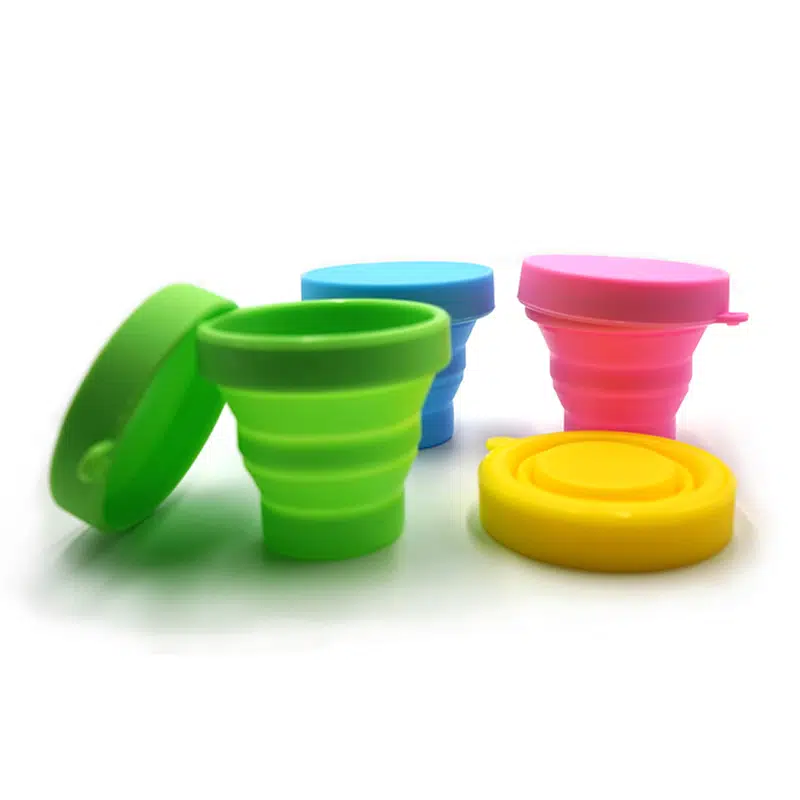
Corrugated Folding Silicone Water Cup |
|---|---|
|
Order Quantity |
Initial Order: 28,000 pcs |
|
Material |
Food-Grade Liquid Silicone |
|
Key Specs |
Hardness: Shore A40 |
|
Certification |
LFGB, FDA, REACH, AS/NZS |
|
Lead Time |
DFM Evaluation: 24 hrs |
Project details
An Australian brand specializing in eco-friendly outdoor furniture needed a foldable, compressible silicone water cup designed for portable use as an alternative to disposable paper and plastic cups. The client had already worked with another supplier, but the resulting prototype showed inadequate folding durability and sealing performance. The lid latch also failed after several hundred opening and closing cycles, preventing the design from proceeding to mass production.

ZSR Group retained the client’s original cup geometry while redesigning three structural areas: the sealing ring, corrugated folding section, and lid latch.
The redesign followed a Design for Manufacturing (DFM) approach, with changes focused on the corrugation profile, sealing interface, and latch reinforcement. The corrugated surface geometry was optimized, a continuous annular sealing lip was incorporated into the lid, and the latch structure was reinforced.
Delivery data
Engineering DFM Assessment
Corrugated Folding Structure
To improve rebound performance and reduce the risk of cracking under repeated folding and pulling, redesigned the geometry and wall-thickness distribution of the cup’s corrugated folds. Sharp transitions were replaced with rounded profiles, while the bottom regions of the corrugations were thickened.
Rather than maintaining a uniform wall thickness, the revised corrugation uses a gradual thickness distribution, with thicker material at the troughs and thinner material at the peaks.
The original design used uniformly thick, right-angled grooves. During repeated folding, these sharp corners acted as stress-concentration points, increasing the likelihood of fatigue damage and cracking. The revised rounded profile and thickened corrugation bottoms provide greater structural stability, distribute folding stress over a larger area, improve resistance to repeated folding, and support smoother rebound after compression. A similar gradient thickness strategy was also validated in our Custom Foldable Silicone Bowl project for a German outdoor brand, which passed more than 5,000 repeated folding cycles without cracking.

Lid Sealing Structure
A continuous silicone sealing lip was added to the inside of the lid to improve sealing reliability. The original sealing interface was susceptible to localized gaps, which could allow liquid to leak during handling or transport. The continuous sealing lip uses the elastic deformation of the silicone material to maintain contact around the sealing circumference, reducing the likelihood of leakage caused by local gaps.
Lid Latch Reinforcement
The lid latch was redesigned to improve durability under repeated opening and closing. An annular reinforcing rib was added at the base of the latch. In the original structure, repeated operation concentrated mechanical stress around the latch connection, resulting in breakage after several hundred opening and closing cycles. The added annular reinforcing rib distributes the load across a larger section of the latch base, reducing localized stress and lowering the risk of fatigue-related failure.
Mold Making, Sample Production & Quality Verification

Mold Processing
ZSR operates 6 advanced CNC machining centers and 4 EDM machining centers for mold manufacturing and processing of liquid silicone cup components.
Venting channels around the corrugated and folded sections were optimized to reduce the risk of incomplete filling and scorching in thin-wall areas. The cup-lid mold surface was mirror-polished to provide a smoother contact surface and support consistent opening and closing performance.

Liquid Silicone Molding
Production is supported by 12 liquid silicone molding machines, with sufficient capacity to mold 28,000 silicone cups within 20 days.
Process parameters are controlled around the thin-wall corrugated sections and reinforced structural areas to maintain dimensional consistency and reduce molding defects that could affect folding, rebound, sealing, or latch operation.

Secondary Vulcanization
After molding, the silicone components undergo secondary vulcanization at 200°C for 2 hours.
The parts are then thoroughly cooled in a ventilated environment. This process is used to remove residual low-molecular-weight volatile compounds from the liquid silicone, reduce residual odor, and support compliance with applicable food-contact requirements.
Quality Inspection
Quality inspection focuses on the functional areas identified during the DFM assessment, including corrugated-fold integrity, rebound performance, lid sealing, latch operation, molded-part appearance, and dimensional consistency.
Inspection is integrated into the production process to identify molding or assembly defects before shipment and maintain the recorded 97.6% first-pass yield across the project.


|
Test |
Condition |
Acceptance Criteria |
|
Repeated Folding Fatigue Test |
Compression and folding ≥ 5,000 cycles |
No whitening or cracking |
|
Leakage Test |
Fill with 95°C hot water and invert for 2 hours |
No leakage |
|
Third-Party Laboratory Testing |
Testing conducted by an independent laboratory |
Passes testing requirements for LFGB, FDA, REACH, and AS/NZS |
|
High- and Low-Temperature Cycling Test |
Alternate between high- and low-temperature environments at -40°C and 220°C |
No deformation or cracking |
|
Lid Opening/Closing Life Test |
Repeatedly open and close the lid ≥ 3,000 cycles |
No loosening or breakage |
Related Silicone Cup Product


Customer reviews & feedback
“They arrived today! Thank you so much! We really like the cups!!”


Custom Silicone Cup
OEM & ODM solutions for brands, retailers, wholesalers, and e-commerce sellers. Food-grade Silicone Cups with FDA/LFGB certification
Other Project


For industrial-scale production, ZSR Group also operates a dedicated silicone compression molding service for custom silicone parts.
