
Custom Silicone Baking Tray | Spanish 2023 Project

|
Product |
Rectangular Silicone Baking Tray |
|---|---|
|
Order Quantity |
Initial Order: 12,000 pcs |
|
Material |
Food-Grade Platinum-Cured Silicone |
|
Key Specs |
Hardness: Shore A50 |
|
Certification |
LFGB, FDA |
|
Lead Time |
DFM Evaluation: 24 hrs |
Project details
A Spanish baking equipment brand wanted to develop a rectangular food-grade silicone tray for baking, freezing, and storage, suitable for ovens, refrigerators, and dishwashers. The client’s original design had three main problems: right-angled corners leading to stress concentration, difficulty in controlling wall thickness uniformity, and a tendency for air bubbles to form on the surface of the finished product.

In response to the customer’s structural optimization requirements, Z.S.R’s engineers conducted a DFM assessment, optimizing the corner structure and draft angle, adding venting channels, and improving the product’s structural stability and lifespan.
Based on the DFM results, the project moved into mold making and sample production, followed by quality verification of the first batch before mass production.
Delivery data
Engineering DFM Assessment
Rounded Corners

The original design used right angles, leading to stress concentration and cracking. Z.S.R added a 4.0 mm rounded corner to the inner corners and a 3.0 mm rounded corner to the outer corners, avoiding stress concentration at sharp corners and reducing the risk of cracking after high and low temperature cycling.
After repeated high-temperature and cooling cycles, the shrinkage rate of the material at sharp corners of the silicone tray is uneven, causing stress accumulation that leads to whitening and cracking. Optimized large rounded corners, both internally and externally, disperse the concentrated stress across the entire arc segment, improving the product’s lifespan.
Increased Draft Angle + Bottom Wall Thickness Adjustment
A 1° draft angle was added to the sidewalls, the bottom wall thickness was increased to 2.0 mm, and the rim thickness was adjusted to 1.8 mm. This prevents pulling on the inner wall during demolding, ensures uniform cooling shrinkage, and results in a flat bottom on the finished product.
During demolding of vertical straight-wall structures, the silicone shrinks and wraps around the core, easily damaging the inner wall. Increasing the draft angle allows the product to release naturally upon mold opening, resulting in a smooth, deformation-free inner wall.
Added Micro-Venting Grooves
To ensure smooth airflow with the material, especially at corners and far ends, engineers added 0.02 mm micro-venting grooves at the four corners and the ends of the long sides of the mold cavity.
The silicone material in rectangular trays flows from the center outwards. The far ends and corners are the most critical filling areas; trapped air can cause material shortages and air bubbles. Micro-venting channels allow air to escape smoothly, resulting in a flawless finished product.
Thickened Rim Edge
The original rim and bottom wall thickness were both 2.0 mm, making the tray prone to collapse and deformation when handled. Z.S.R thickened the rim to 2.6 mm and added a 1.5 mm rounded corner transition.
The rim is a stress-bearing point when holding the tray; thin walls can deform, affecting the user experience. The increased wall thickness, combined with rounded corners, results in smooth, non-sharp edges on the finished product, providing good support when held.
Mold Making, Sample Production & Quality Verification

Mold Processing
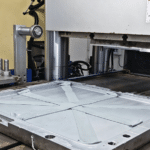
Z.S.R Group is equipped with 10 advanced CNC machining centers and 4 EDM machines, capable of creating silicone tray molds.
Silicone Molding
Production is supported by 48 solid molding machines, 12 liquid molding machines, and 13 injection molding silicone machines. This product uses solid molding, one-piece molding, one mold per piece. Over 10 printing and spraying production lines also allow for printing logos or patterns on the silicone trays.

Secondary Vulcanization
After molding, the silicone trays undergo secondary vulcanization at 200°C for 2 hours.
The secondary curing process removes small-molecule volatiles from the silicone, reduces product odor and exudation, and ensures the trays meet food contact safety requirements.
Quality Inspection
|
Test |
Condition |
Acceptance Criteria |
Result |
|---|---|---|---|
|
Folding Fatigue Test |
Four corners repeatedly folded 5,000 times |
No cracks, no obvious stress whitening |
Pass |
|
Tensile Strength Test |
Universal material testing machine |
Tensile strength ≥ 7.5 MPa |
Pass |
|
Tear Strength Test |
Standard notched tear test |
Tear strength ≥ 22 kN/m |
Pass |
|
High & Low Temperature Cycling Test |
-40°C freezing ↔ 230°C baking, 50 cycles |
No deformation, cracking, hardening, or oil bleeding |
Pass |
|
Warpage Flatness Test |
Room temperature static placement for 24 h |
Four-corner warp height ≤ 1.5 mm |
Pass |
|
Dimensional Tolerance Inspection |
2D optical vision measuring machine |
Dimensional deviation ≤ ±0.20 mm |
Pass |
|
Visual Inspection |
100% visual inspection |
No bubbles, missing material, flash, or scratches |
Pass |
|
Food Migration Test |
LFGB food contact test |
Meets food contact requirements |
Pass |
The production samples passed the specified folding fatigue, tensile strength, tear strength, temperature cycling, warpage, dimensional, visual, and food migration inspections. In particular, no cracks or stress whitening was observed after the four corners were repeatedly folded 5,000 times.
Related Product


Customer reviews & feedback
“Hi everyone, the silicone tray is fantastic! Overall, you did an excellent job!”
Custom Silicone Baking Tray
OEM & ODM solutions for brands, retailers, wholesalers, and Ecommerce sellers. Food-grade silicone baking trays with LFGB/FDA compliance.
Other Project


For industrial-scale production, ZSR Group also operates a dedicated silicone compression molding service for custom silicone parts.
