
Custom Silicone Coating Brush | French 2023 Project

|
Product |
One-Piece Silicone Coating Brush for Baking |
|---|---|
|
Order Quantity |
Initial Order: 40,000 pcs |
|
Material |
Food-Grade Solid Silicone |
|
Key Specs |
Hardness: Shore A40 Temperature Resistance: -40°C to 230°C |
|
Certification |
GB 4806.11, RoHS, REACH, BPA-Free |
|
Lead Time |
DFM Evaluation: 24 hrs |
Project details
A French baking kitchenware brand, specializing in food-grade kitchen utensils for home use, wanted to develop a silicone brush for brushing on oil and spreading sauces. After prototyping the original design, the client discovered that the bristles were prone to breakage at the base, the bristle tips were missing material, and the connection between the handle and the brush head was prone to cracking.

Z.S.R completed a DFM assessment within 24 hours to address the shortcomings of the sample, optimizing the bristle structure, connection areas, and mold venting to improve the product’s durability while maintaining its soft feel.
Based on the DFM results, the project moved into mold making and sample production, followed by quality verification of the first batch before mass production.
Delivery data
Engineering DFM Assessment

Rounded Bristle Roots + Gradual Thinning
To improve the bristle’s resistance to bending, Z.S.R optimized all bristle roots from right angles to a 0.8 mm rounded corner, thickened the root to 2.2 mm, and gradually thinned the tip to 1.2 mm. The bristle spacing was adjusted to 2.0 mm.
The right-angled roots of the brush bristles experience concentrated stress, making them prone to whitening and breakage after repeated stress. The rounded corner structure disperses the stress across the entire circumference of the root, improving the fatigue durability of the bristles. The thinner bristle tips provide a smooth and gentle application of oils, preventing scratches on baking utensils.
Smooth Transition at Handle-Brush Head Connection + Uniform Wall Thickness
The engineering team added a 2.5 mm rounded transition at the handle-brush head connection and standardized the handle’s main body wall thickness to 2.0 mm, reducing internal stress caused by abrupt changes in thickness.
The abrupt change in wall thickness from the handle to the brush head, coupled with inconsistent molding and cooling rates, generates residual internal stress. Repeated bending to release this stress leads to cracking at the thickness transition point. A smooth, large-arc transition combined with uniform wall thickness reduces the risk of cracking from the outset.
Micro-Venting Grooves in the Bristle Area
Dense bristles create a narrow cavity, making it difficult for air to escape during molding, leading to insufficient material and air bubbles at the bristle tips. Engineers created 0.02 mm deep micro-venting grooves in the bristle mold cavity to improve material filling.
The slender bristle cavity traps air during material filling, easily causing material shortages and air bubbles. Adding venting grooves to the mold cavity allows air to escape with the material flow, ensuring each bristle is formed intact.
Mold Making, Sample Production & Quality Verification

Mold Processing
Z.S.R Group is equipped with 10 advanced CNC machining centers and 4 EDM machines for silicone coating brush mold making. The cavity undergoes mirror polishing, and high-precision areas such as fine brush bristles and hanging holes are precisely machined.

Silicone Molding
Production is supported by 48 solid molding machines, 12 liquid molding machines, and 13 injection molding silicone machines, enabling the rapid molding of 25,000 silicone coating brushes within 20 days. Over 10 printing and spraying production lines also allow for printing logos or patterns on the silicone brushes.

Secondary Vulcanization
After molding, the silicone coating brushes undergo secondary vulcanization at 200°C for 2 hours.
The secondary curing process removes small-molecule volatiles from the silicone, reduces product odor, and ensures the brushes meet food contact safety standards.
Quality Inspection
|
Test |
Condition |
Acceptance Criteria |
Result |
|---|---|---|---|
|
Bristle Bend Fatigue Test |
Repeated bending of bristles for 5,000 cycles |
No cracks, breakage or obvious whitening at bristle roots; bristles remain intact |
Pass |
|
Bristle Temperature Resistance Test |
20 high-low temperature cycles between -40°C and 230°C |
No deformation, cracking, hardening or obvious performance change |
Pass |
|
Handle Joint Bend Test |
Repeated bending at the joint between handle and brush head for 3,000 cycles |
No cracks, whitening or structural loosening in the connection area |
Pass |
|
Hanging Hole Tensile Test |
Hang 2 kg weight on the hole for 24 hours |
No tearing, deformation or cracks on the hanging hole |
Pass |
|
Bristle Molding Integrity Inspection |
Microscopic observation of bristle tips and roots |
Bristles intact, no material shortage, bubbles or burrs |
Pass |
|
Spreading Performance Test |
Continuous spreading with grease and sauces |
Uniform coating; soft bristles, not easy to shed or deform |
Pass |
|
Dimensional Precision Inspection |
Total length, bristle length, handle width measured by caliper and vision measuring machine |
All key dimensions controlled within ±0.15 mm tolerance |
Pass |
|
Visual Inspection |
100% visual inspection of products |
No bubbles, material shortage, scratches or obvious sink marks |
Pass |
The production samples passed the specified bristle fatigue, temperature resistance, handle joint, hanging hole, molding integrity, spreading performance, dimensional, and visual inspections. In particular, no cracks or breakage was observed after 5,000 bristle bending cycles.
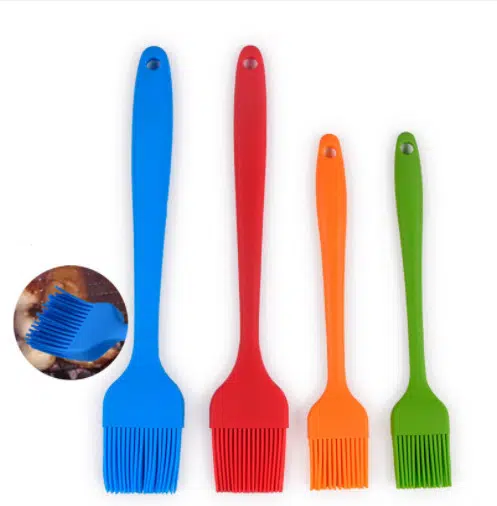
Related Silicone Brush Product


Customer reviews & feedback
“Thank you so much for delivering the product to me so quickly. Also, the brush is really beautiful. My customers all love it.” The French customer still keeps in touch with Z.S.R and placed an order for custom silicone food bags in June 2025.

Custom Silicone Coating Brush
OEM & ODM solutions for brands, retailers, wholesalers, and Ecommerce sellers. Food-grade silicone coating brushes with RoHS/REACH compliance.
Other Project


For industrial-scale production, ZSR Group also operates a dedicated silicone compression molding service for custom silicone parts.
