
Custom Silicone Phone Back Cover | Korean 2023 Project

|
Product |
Liquid Silicone Phone Back Case Protective Cover |
|---|---|
|
Order Quantity |
Initial Order: 40,000 pcs |
|
Material |
Food-Grade Liquid Silicone |
|
Key Specs |
Hardness: Shore A40 |
|
Certification |
FDA, REACH, RoHS |
|
Lead Time |
DFM Evaluation: 24 hrs |
Project details
A South Korean 3C digital accessory brand specializes in affordable luxury and skin-friendly phone cases. During initial collaborations with other suppliers, the client discovered two main problems with the original solutions: the corners of the phone cases were prone to cracking, and the buttons felt too stiff.

The client learned about Z.S.R’s years of experience in custom manufacturing through social media and began collaborating. Z.S.R’s engineering team produced a DFM report within 24 hours, optimizing the four-corner cushioning and button structure. The sample passed drop and button tests.
Based on the DFM results, the project moved into mold making and sample production, followed by quality verification of the first batch before mass production.
Delivery data
Engineering DFM Assessment
Optimized Corner Buffer Structure

Z.S.R increased the wall thickness of the four corners of the original phone case from 1.6 mm to 2.0 mm, adopted a large R6 mm rounded transition at the corners, and added “I”-shaped buffer ribs to the four corners of the inner side of the case.
The four corners of the phone case are vulnerable to impact during drops. Thin walls at right angles concentrate stress, making the case prone to cracking upon impact. Thickened corners, rounded edges, and cushioning ribs allow the impact force to be evenly distributed along the case, improving drop resistance and lifespan.
Improved Button Feel
To reduce button pressure, the engineering team reduced the wall thickness of the button area from 1.8 mm to 1.5 mm, leaving a 0.6 mm gap between the case and the buttons, and performed micro-particle etching on the button surface. In addition, the center of the button is precisely aligned with the phone’s buttons.
Excessive wall thickness in the button area, rigidly connected to the case, affects button feel and responsiveness. Thinning the button area wall thickness, combined with clearance and precise alignment, ensures a smooth and responsive button feel.
Tight Fit and Dustproof Design for the Lens Frame
The original design had an excessively large gap between the lens frame and the phone’s camera, making it prone to dust accumulation. The engineering team precisely controlled the lens frame wall thickness to 0.8 mm ± 0.05 mm, and added a 0.3 mm high-sealing raised ring along the inner edge.
Large gaps between the phone lens and the case allow dust to accumulate over time. The added sealing ring fits snugly around the lens, and the lens frame thickness is precisely controlled, preventing obstruction of lens imaging and preventing dust from entering.

Mold Making, Sample Production & Quality Verification

Mold Processing
Z.S.R Group is equipped with 10 advanced CNC machining centers and 4 EDM machines for silicone phone case mold making. High-precision areas such as the frame and buttons undergo mirror polishing (Ra0.2 μm), and the parting surface is high-precision ground to ensure a burr-free finish.

Silicone Molding
Production is supported by 48 solid molding machines, 12 liquid molding machines, and 13 injection molding silicone machines, enabling the rapid molding of 30,000 silicone phone cases within 20 days. Over 10 printing and spraying production lines also allow for printing logos or patterns on the silicone phone cases.

Secondary Vulcanization
After molding, the silicone phone cases undergo secondary vulcanization at 200°C for 2 hours.
The secondary curing process removes small-molecule volatiles from the silicone, ensuring safety for skin contact.
Quality Inspection
|
Test |
Condition |
Acceptance Criteria |
Result |
|---|---|---|---|
|
Four-Corner Drop Resistance Test |
Repeated drop 6 times from 1.5 m height onto four corners |
No cracking or damage to the case; no abnormality in camera area |
Pass |
|
Button Durability Test |
Repeated pressing of volume & power buttons for 10,000 cycles |
Smooth rebound, stable tactile feel, no jamming |
Pass |
|
Camera Lens Fitting Test |
Inspect gap between lens frame and lens after assembly |
Tight fit, no obvious gaps for dust ingress |
Pass |
|
Dimensional Precision Inspection |
Key dimensions measured by caliper and vision measuring machine |
Dimensions meet ±0.08 mm tolerance |
Pass |
|
Visual Inspection |
Full surface inspection of case |
No flash, bubbles, sink marks or scratches |
Pass |
|
Hazardous Substance Test |
REACH SVHC & RoHS testing |
Compliant with limit requirements |
Pass |
The production samples passed the specified drop resistance, button durability, lens fitting, dimensional, visual, and hazardous substance inspections. In particular, smooth rebound with no jamming was maintained after 10,000 button pressing cycles.
Related Product


Customer reviews & feedback
“I really like the quality; it provides long-lasting protection for my phone, which is exactly what I wanted!” The customer placed a repeat order, and in 2025 ordered another 30,000 units.
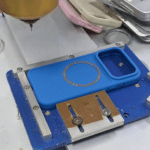

Custom Silicone Phone Case
OEM & ODM solutions for brands, retailers, wholesalers, and Ecommerce sellers. Liquid silicone phone cases with FDA/REACH/RoHS compliance.
Other Project


For industrial-scale production, ZSR Group also operates a dedicated silicone compression molding service for custom silicone parts.
